

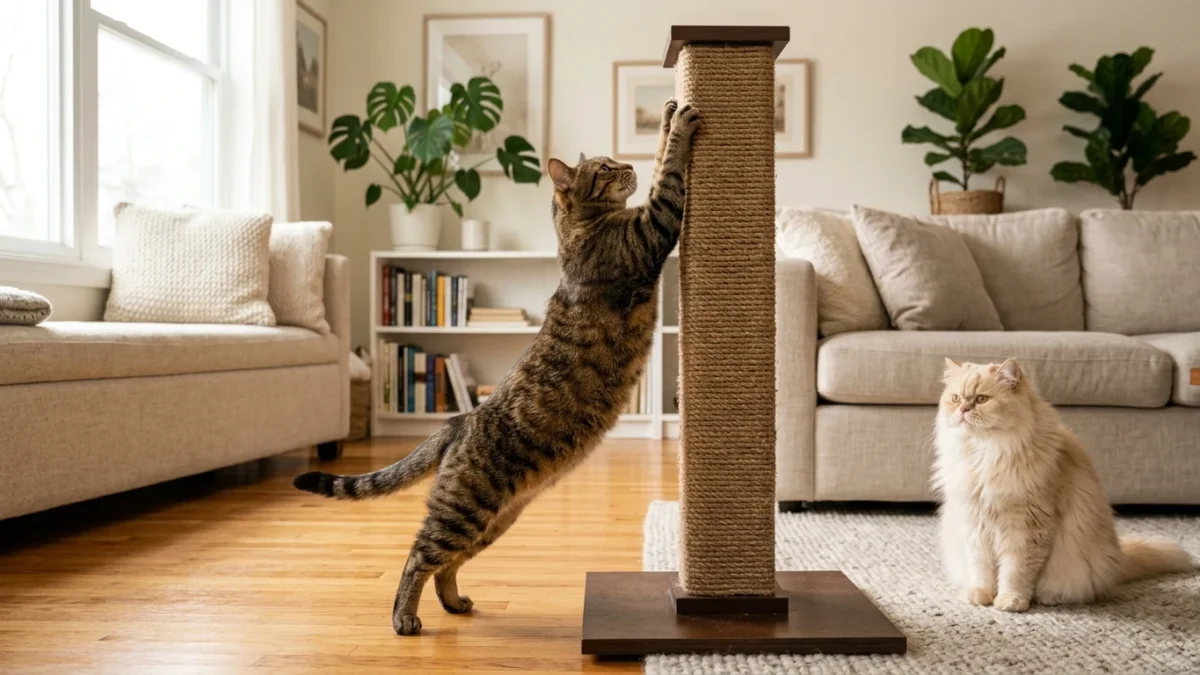
Your cat walks past the toy basket, stretches toward the couch, and gets straight to work. The expression is wonderfully serious. The furniture damage is less entertaining.
Cat scratching can look like a funny little household ritual, but it serves real purposes. Understanding those purposes gives you a better starting point than trying to stop every scratch.
Whether you live with a striped tabby cat or a fluffy Persian cat, this guide will help you think about scratching surfaces, placement and everyday routines. The goal is simple: give your cat an acceptable place to scratch while making your home easier to share.
Why Do Cats Scratch?
Scratching furniture is not evidence that your cat is plotting revenge.
Cornell’s Feline Health Center explains that scratching leaves scent from glands in the paws and helps remove the outer claw sheath. Humane World for Animals also describes scratching as normal behavior that can involve stretching and expressing emotions.
That changes the question. Instead of asking, “How do I make my cat stop scratching?” ask, “Where can my cat comfortably do this?”
A scratching post or pad provides an outlet. Choosing and positioning it thoughtfully is the practical part.
Funny Cats, Serious Scratching Needs
There is something amusing about a tiny animal approaching a scratching post as though it has an important appointment.
Enjoy the moment, but keep the humor in the storytelling. A cat scratching furniture is not automatically naughty, jealous or deliberately trying to annoy you.
Watch what happens before and after the scratching. Write down the surface, location and time of day. Those details give you a clearer picture than a label such as “stubborn.”
For example, “scratches the same rug after getting up” is a useful observation. “Hates the new scratching post” is an interpretation you may need to test.
Tabby Cat and Persian Cat: An Important Difference
A tabby cat and a Persian cat are not two equivalent breed categories.
The Cat Fanciers’ Association explains that tabby describes a coat pattern, not a breed. Persian is a breed, and the CFA Persian standard includes tabby color classes.
In other words, the terms can overlap.
Do not choose a scratching setup simply because a cat has stripes or a long coat. Start with what that individual cat actually does: the surfaces it approaches, the position it uses and whether the scratcher feels secure.
This article does not claim that Persian cats scratch less or that tabby cats are more destructive. Those assumptions would not help you choose a better setup.
7 Helpful Cat Scratching Tips
1. Observe Before You Buy Another Scratcher
Before ordering a replacement, make a short observation note.
Where is the scratching happening? Is your cat reaching upward, stretching forward or working on a flat surface? Is the target always the same couch corner?
Use those answers to decide what to try next.
This is not a formal behavior assessment. It is a practical way to avoid buying another version of something your cat is already ignoring.
2. Match the Scratching Position
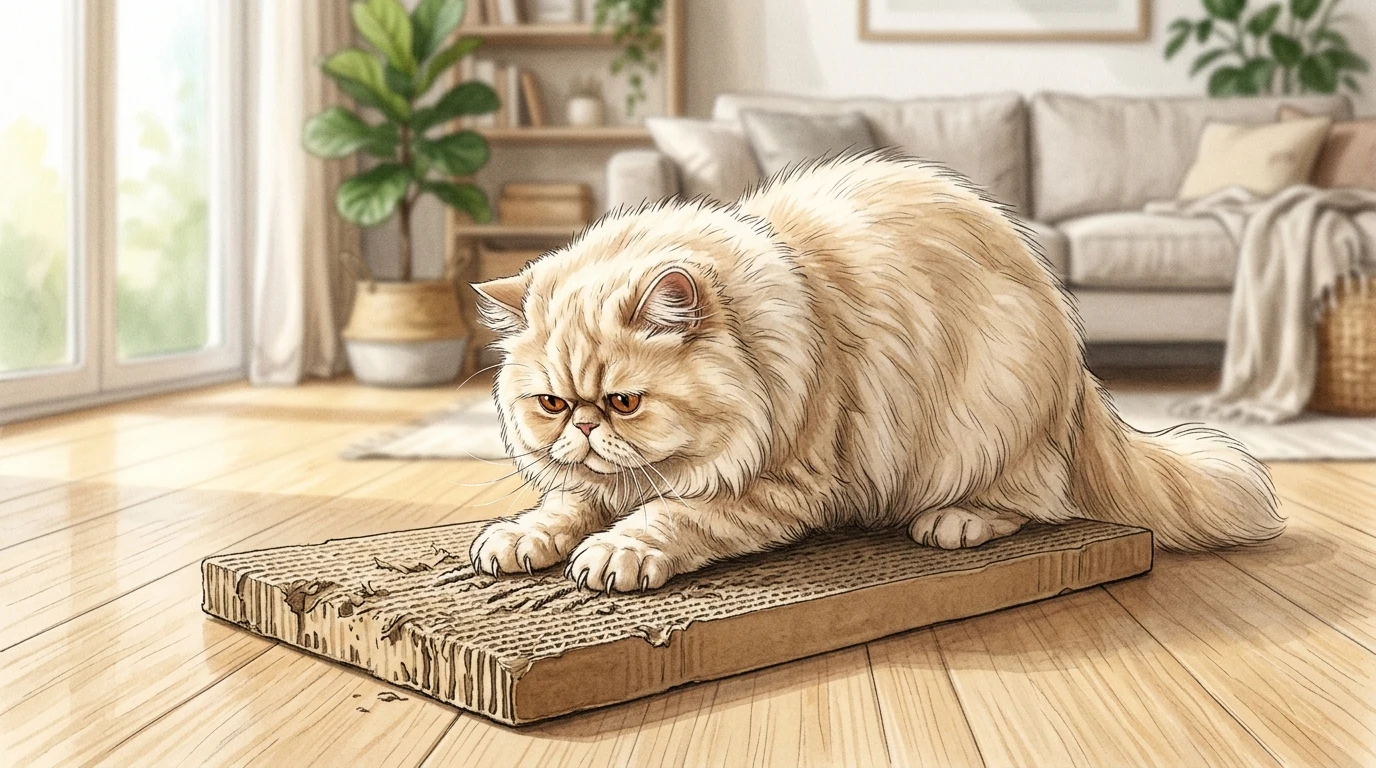
Cats Protection recommends a horizontal scratching pad for cats that prefer surfaces such as carpets.
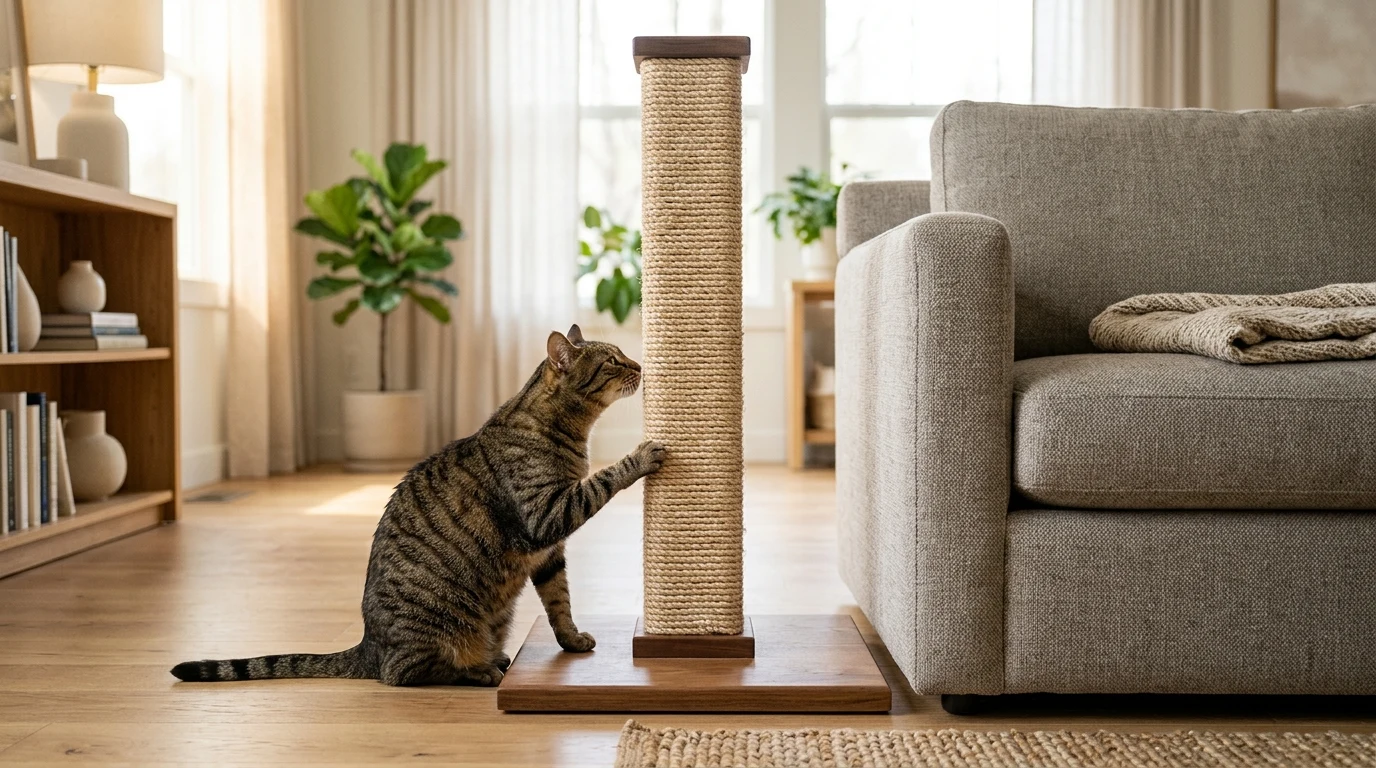
If your cat reaches up a vertical surface, consider an upright option. If the action happens across a rug, try a flat pad.
Rather than expecting one style to suit every cat, offer a choice and observe which one gets used.
3. Check Stability and Stretching Space
A scratching surface needs to stay in place during use.
Check the base and assembly instructions before introducing it. For an upright post, choose a height that allows your cat to stretch comfortably.
Humane World for Animals recommends sturdy scratching options suited to the cat’s preferences.
If a scratcher slides or rocks, address that before judging whether your cat likes the material. A stable setup is a better starting point for a fair trial.
4. Put the Scratcher Where It Is Needed
A neatly hidden scratching post may fit the room beautifully while missing the spot your cat actually uses.
Cats Protection recommends thinking about locations where cats already scratch and places near resting areas.
Try placing an appropriate scratcher close to the existing target. Keep it accessible rather than squeezed behind furniture.
Take a photo of the arrangement so you can compare changes later. If you move several things at once, it becomes harder to tell which adjustment helped.
5. Encourage Use Without Forcing the Paws
Allow your cat to investigate.
Cats Protection specifically advises against lifting a cat’s legs and making its paws scratch the post. That experience can put the cat off using it.
Animal Humane Society recommends redirecting scratching toward a suitable post rather than reprimanding the cat.
Think invitation, not demonstration by force. Give your cat the opportunity to use the surface voluntarily.
6. Protect the Furniture While Offering an Alternative
Furniture protection and a suitable scratcher should work together.
Choose a secure, pet-appropriate protective cover and follow its instructions. Avoid loose or damaged materials your cat may chew or become caught in.
Do not make removing access to the couch your entire plan. Keep the alternative nearby and observe whether your cat uses it.
Cornell’s guidance approaches unwanted scratching by directing the behavior toward acceptable surfaces. The purpose is to change the destination, not eliminate the need.
7. Adjust One Part of the Setup at a Time
If the scratcher remains untouched, use a simple troubleshooting order:
- Check its location.
- Check whether it stays steady.
- Compare a vertical surface with a horizontal one.
- Try a different suitable texture.
- Observe again before making another change.
Treat this as an organizing method, not a guaranteed training schedule.
Keep a short note of what you changed and what your cat did afterward. It is easier to make a useful decision when you can compare actual observations.
A Quick Scratcher-Setup Checklist
Before buying more equipment, ask:
- Can my cat reach the scratcher easily?
- Does it remain steady during use?
- Does its position resemble the surface my cat already scratches?
- Is there room for a comfortable stretch?
- Is it near a place my cat chooses to spend time?
- Have I allowed exploration without forcing contact?
You do not need a showroom full of cat furniture. Begin with a suitable option and a clear reason for where you place it.
Scratching Furniture Is Different From Scratching Skin
The word “scratching” can describe two different situations.
A cat using its claws on a post or couch is different from a cat repeatedly scratching its body.
PDSA advises contacting a veterinarian if a cat scratches or licks itself more than normal, particularly when there is hair loss, a rash or sore skin.
Do not assume frequent body scratching is just a funny habit or that another toy will solve it. This article is about scratching objects, not diagnosing itchy skin.
Mistakes Worth Avoiding
Treating Normal Scratching as Misbehavior
Animal Humane Society describes scratching as normal and advises redirection rather than reprimands.
Focus your effort on providing and adjusting an acceptable outlet.
Choosing by Appearance Alone
A beautiful scratcher can still be the wrong choice for your setup.
Before purchasing, consider its dimensions, stability, surface and intended position. Then compare those features with your observations.
Assuming Coat Pattern Predicts Behavior
“Tabby” tells you about markings. It does not tell you which scratching texture that cat will choose.
Similarly, choosing a scratcher for a Persian cat should involve observing the individual rather than relying on a breed stereotype.
Changing Everything at Once
If you replace the scratcher, move it to another room and introduce a new surface on the same day, you have several changes to interpret.
A more manageable experiment is to adjust one feature and keep notes.
Frequently Asked Questions
Is cat scratching normal?
Yes. Scratching objects is a normal feline behavior. Cornell describes its roles in scent marking and removing the outer claw sheath.
Will a Persian cat need a scratching surface?
Provide an appropriate scratching option and watch how the individual cat uses it. Do not assume a breed label removes the need for an outlet for normal feline behavior.
Is a tabby cat a separate breed?
No. According to the Cat Fanciers’ Association, tabby is a coat pattern. It can occur in different kinds of cats.
Why does my cat ignore the scratching post?
Start by checking placement, stability, orientation and texture. These are useful features to evaluate, but they do not identify the exact reason for every cat.
Should I move my cat’s paws on the post?
No. Cats Protection advises against this because cats may find it unpleasant and avoid the post.
What if my cat scratches its body constantly?
That is a different issue from scratching furniture. Contact your veterinarian about increased self-scratching or licking, especially with irritated skin or hair loss.
Give Those Paws a Better Place to Go
Funny cats can make everyday life more entertaining, but protecting your couch does not require treating your cat as the villain.
Start with observation. Offer a suitable scratching surface, position it thoughtfully and adjust the setup with patience.
Whether your companion is a tabby cat, a Persian cat or another much-loved feline, let the individual guide your choices.
Does your cat prefer a tall post, a flat cardboard pad or a particular corner of the room? Share your experience in the comments.
Table of Contents
- Why Do Cats Scratch?
- Funny Cats, Serious Scratching Needs
- Tabby Cat and Persian Cat: An Important Difference
- 7 Helpful Cat Scratching Tips
- 1. Observe Before You Buy Another Scratcher
- 2. Match the Scratching Position
- 3. Check Stability and Stretching Space
- 4. Put the Scratcher Where It Is Needed
- 5. Encourage Use Without Forcing the Paws
- 6. Protect the Furniture While Offering an Alternative
- 7. Adjust One Part of the Setup at a Time
- A Quick Scratcher-Setup Checklist
- Scratching Furniture Is Different From Scratching Skin
- Mistakes Worth Avoiding
- Treating Normal Scratching as Misbehavior
- Choosing by Appearance Alone
- Assuming Coat Pattern Predicts Behavior
- Changing Everything at Once
- Frequently Asked Questions
- Is cat scratching normal?
- Will a Persian cat need a scratching surface?
- Is a tabby cat a separate breed?
- Why does my cat ignore the scratching post?
- Should I move my cat’s paws on the post?
- What if my cat scratches its body constantly?
- Give Those Paws a Better Place to Go