

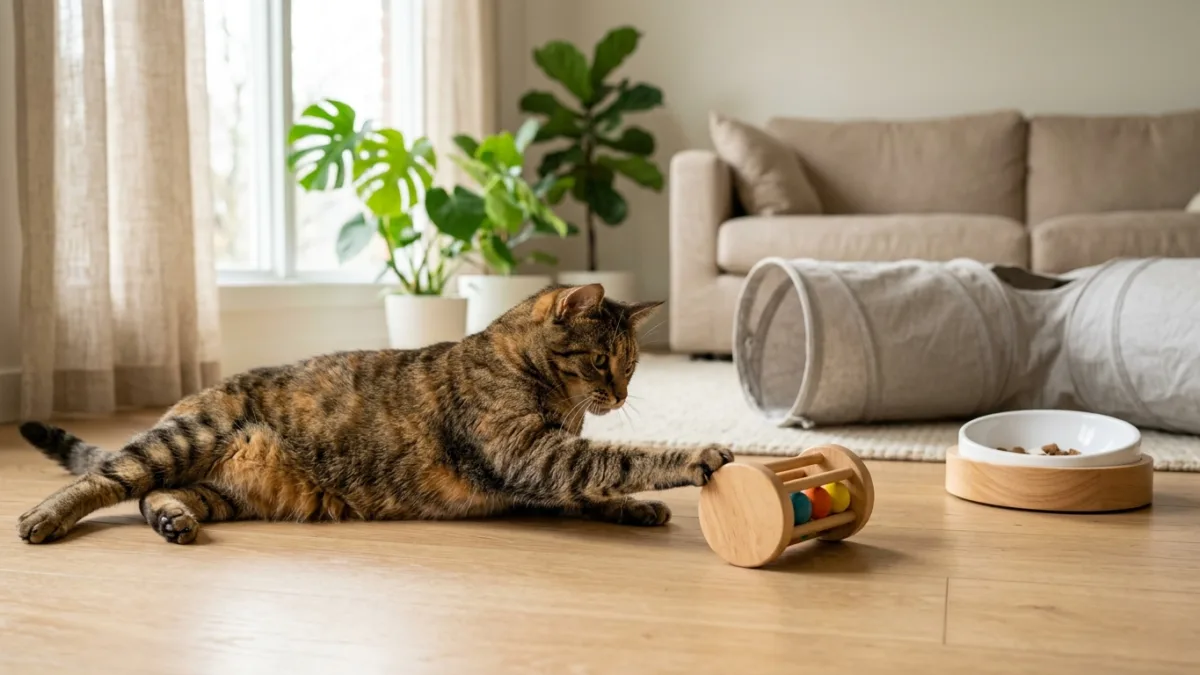
A new toy arrives, you unpack it, and your cat heads straight for the box. Before buying another gadget, it helps to ask a different question: what kind of play does your cat actually enjoy?
Interactive cat toys give you ways to explore that question together. Some invite a chase, others create a hiding place, and puzzle feeders make food part of an activity. The aim is not to fill the room with toys. It is to find something your cat chooses to engage with.
This guide covers seven play ideas, what to look for when choosing toys, and how to build a routine without turning every session into a workout.
Table of Contents
What Are Interactive Cat Toys?
Interactive cat toys invite your cat to respond—by following something you move, batting an object, exploring a space or working out how to reach food.
“Interactive” does not have to mean electronic. A toy you move by hand can offer interaction too.
Cornell’s Feline Health Center explains that toys can encourage exercise, problem-solving and natural behaviours such as stalking and pouncing. It also points out that entertaining toys need not be expensive.
Start With Your Cat’s Play Style
Before choosing something new, watch an ordinary play session.
Does your cat follow movement across the floor? Wait behind furniture before pouncing? Prefer batting objects rather than chasing them?
Use those observations as a starting point. The suggestions below are options to explore, not a promise that every cat will enjoy every toy.
| What you notice | An option to try | How to begin |
|---|---|---|
| Your cat follows moving objects | A wand toy | Move it gently away from your cat |
| Your cat bats objects across the floor | A sturdy rolling toy | Offer a short roll within easy reach |
| Your cat investigates food puzzles | A beginner puzzle feeder | Start with an easy setting |
| Your cat likes hiding before approaching | A tunnel or cardboard box | Let your cat explore before adding play |
| Your cat watches but rarely joins in | A quieter, slower presentation | Allow time to observe without pressure |
7 Interactive Cat Toys and Play Ideas
1. Wand Toys for Playing Together
A wand toy lets you control the action while keeping your hands away from claws and teeth.
Try moving the toy along the floor instead of repeatedly waving it at your cat’s face. Pause, change direction and give your cat opportunities to approach.
Battersea recommends prey-like movement and letting cats catch their target. The catch matters: play should offer something achievable, rather than an endless chase.
Stay involved throughout the session, and put toys with string away afterwards.
2. Rolling Toys for a Simple Chase
A rolling toy gives you a straightforward activity to try before investing in anything complicated.
Begin with a gentle roll across a clear patch of floor. Then wait. There is no need to keep pushing it towards a cat that is not interested.
When comparing options, check the size, construction and any parts that could come loose. Cornell advises avoiding small detachable pieces and strand-like components that could be swallowed.
3. Puzzle Feeders for Food-Based Play
Puzzle feeders create a different kind of activity: finding or working out how to reach food.
Choose an easy introduction. Cats Protection notes that cats accustomed to eating from a bowl may need time to understand a puzzle feeder. PDSA also includes puzzle feeders among its suggested enrichment activities.
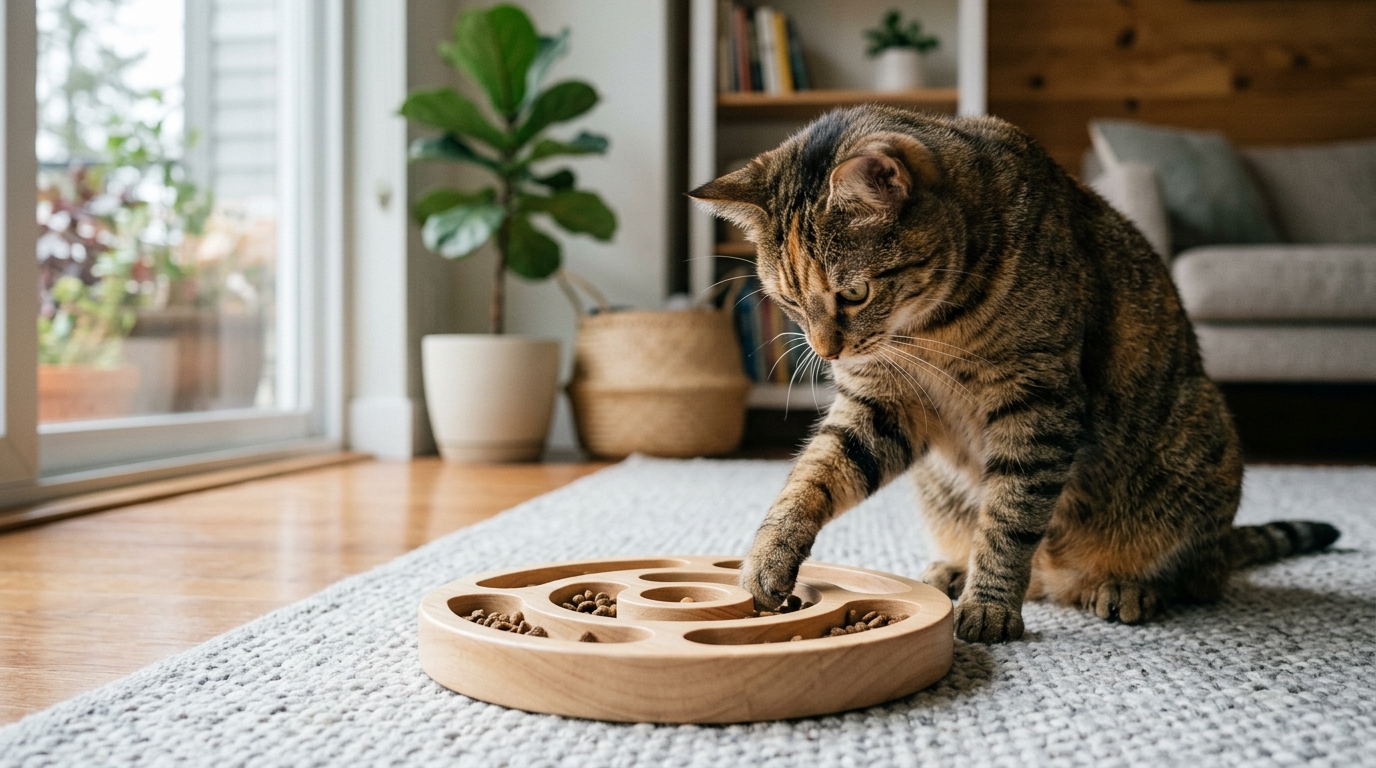
Follow the feeder’s instructions and your cat’s existing feeding plan. The point is to offer an achievable activity, not to make meals frustrating.
4. Tunnels for Hide-and-Seek Play
A tunnel is another option if you want to experiment with a different play setup.
Start by letting your cat investigate it without moving toys around the entrance. If your cat seems comfortable, try moving a separate toy outside one end.
Keep the entrance open and let your cat choose whether to join in. Consider the tunnel part of the play space rather than something your cat must use.
5. Cardboard Boxes for a Budget-Friendly Setup
You do not need an elaborate cardboard castle to test this idea.
Place a suitable box on the floor and let your cat explore. If it becomes a favourite spot, you can use the surrounding space for a supervised toy session.
Cornell lists cardboard boxes among inexpensive objects that can entertain cats. It also recommends checking the play environment for falling objects and other hazards.
Keep the setup simple enough to inspect and replace easily.
6. Motorised Toys for Supervised Trials
If you want to try an electronic toy, treat the first session as an introduction.
Check the manufacturer’s age, supervision, cleaning and battery instructions. Start with a quiet setting if one is available, and give your cat space to approach or leave.
Observe the actual response before deciding whether it deserves a place in your routine. A flashing light or moving mechanism might look exciting to us; your cat gets the final vote.
7. A Rotating Selection of Familiar Toys
Your next play idea does not necessarily require a purchase.
PDSA suggests offering a small selection and swapping toys every few days to maintain interest.
You could keep a simple note:
- Which toy did your cat approach?
- What movement encouraged participation?
- Did your cat prefer chasing, watching or batting?
- When did your cat choose to stop?
Use those observations when deciding what to bring out next.
How to Make Playtime More Engaging
The way you use interactive cat toys deserves as much attention as the toy itself.
For a wand session, think of a small sequence: introduce movement, pause, allow an approach, then offer a catch. Avoid making the toy permanently unreachable.
Battersea’s guidance emphasises imitating prey and providing opportunities to catch the toy. It also advises using toys rather than your hands or feet as targets.
Keep sessions short enough that your cat remains willing to participate. Cats Protection recommends short, frequent opportunities for play rather than expecting one long session to suit every cat.
There is no need to judge success by dramatic jumps. Make room for your cat’s preferred pace.
Safety Checks Before You Start
Before introducing a toy:
- Inspect it for damage and loose components.
- Follow its supervision and maintenance instructions.
- Check that the play area is clear.
- Put string-based toys away after supervised use.
Cats Protection warns that swallowed string can cause serious internal problems. PDSA likewise advises against leaving cats unattended with string, thread, twine or wool.
What About Laser Toys?
Cats Protection and Battersea advise against laser pointers because cats cannot physically catch the dot, which can lead to frustration. A physical toy offers something they can actually capture.
A Simple Way to Choose Your First Toy
If the choice feels overwhelming, start with an experiment rather than a shopping list.
Pick one activity from this guide. Try it in a calm, clear space. Notice how your cat responds, and change one thing at a time: the movement, location or toy.
That approach gives you something useful to work with. Instead of asking whether a toy is popular, you can ask whether your cat enjoyed using it.
Frequently Asked Questions
Do interactive cat toys need batteries?
No. Wand toys, rolling toys and puzzle feeders provide ways to interact without requiring an electronic mechanism. Choose the activity first, then decide whether a gadget adds anything useful.
Do expensive cat toys work better?
Price alone is not a useful starting point. Cornell notes that simple objects, including cardboard boxes, can provide entertainment. Start with your cat’s response rather than the price tag.
Can I leave a wand toy out while I am away?
Put string-based toys away after play. Cats Protection and PDSA warn about the risks of unsupervised access to string and similar materials.
What if my cat ignores a new toy?
Try a different presentation before buying another one. Cats Protection suggests that finding a cat’s preferred toy and changing how it moves can help encourage interest. Do not force participation.
Choose the Play Your Cat Comes Back For
You do not need a basket overflowing with interactive cat toys. Start with a manageable choice, make time to use it, and pay attention to what your cat enjoys.
The next useful addition might be a puzzle feeder, a rolling toy or simply a cardboard box. Let your cat’s response guide the next step.
Which does your cat choose first: a moving toy, a food puzzle or the empty box? Let us know your preferred interactive cat toys methods below.
Read next
- Indoor Cat Enrichment: 7 Vet-Approved Ways to Beat Feline Boredom
- Why Do Cats Purr? The Healing Frequencies and Hidden Meanings of Feline Vibrations
- Introducing a New Dog or Cat to Your Resident Pet: A Step-by-Step Gentle Protocol
Sources and further reading
- Cornell — Safe toys and gifts
- Cats Protection — Cats and play
- Cats Protection — Keeping your cat safe
- Cats Protection — Keeping your cat happy
- Cats Protection — Boredom busters
- PDSA — Exercising your cat
- Battersea — Playing with your cat
