
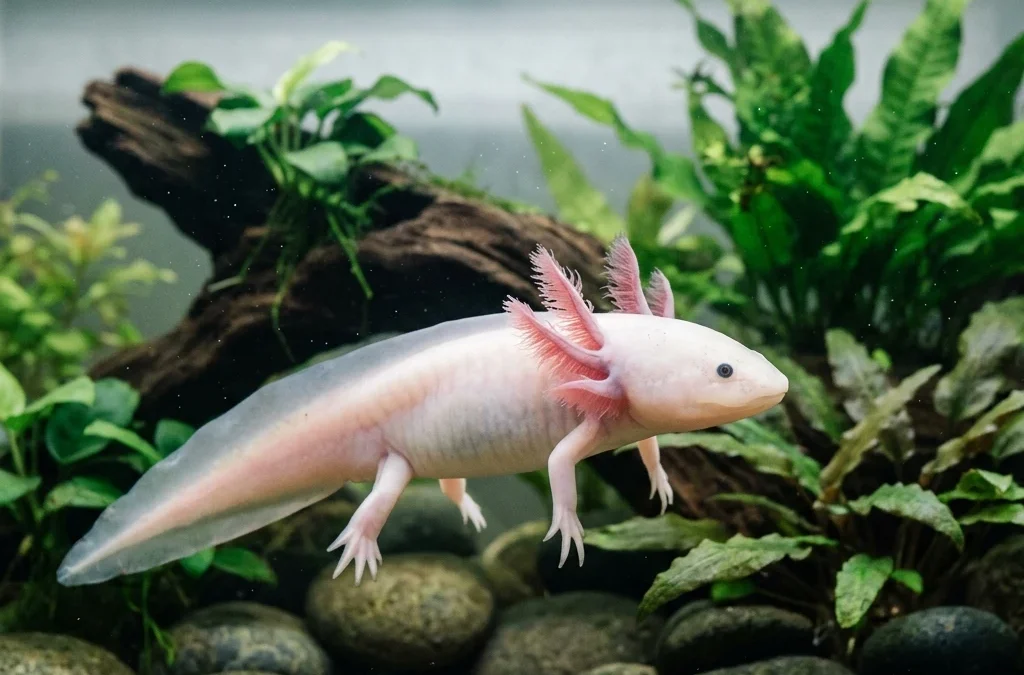
Axolotls look as though someone gave a salamander a crown of feathers and asked it to stay underwater. Their unusual appearance draws attention, but their biology is even more interesting.
What are those frilly structures around the head? Why do these animals keep features that other salamanders lose? And how can an animal seen so often in photographs still face serious trouble in the wild?
The answers connect a remarkable amphibian with a very real freshwater habitat in Mexico. Here is a closer look at axolotl facts, food, regeneration, and the difference between online popularity and conservation.
Table of Contents
What Are Axolotls?
Axolotls are salamanders, which makes them amphibians—not fish.
Their scientific name is Ambystoma mexicanum. Although “Mexican walking fish” is sometimes used as a common name, it can give the wrong impression about what the animal actually is.
A useful starting point is to think of an aquatic salamander with an unusual life cycle. Its appearance is not simply a temporary stage before an ordinary land-dwelling adult.
San Diego Zoo’s axolotl profile
Why Do Axolotls Have Feathery Gills?
The branching structures beside an axolotl’s head are external gills.
Axolotls normally retain these and other juvenile features as they mature. The Natural History Museum explains this retention using the terms neoteny and paedomorphism.
That does not mean an adult axolotl is literally a baby. It can become reproductively mature while keeping features associated with a younger stage in other salamanders.
It is an important distinction behind the familiar phrase “the animal that never grows up.” The phrase is memorable, but the biology is more precise.
Axolotls at a Glance
| Question | Short answer |
|---|---|
| What kind of animal are they? | Aquatic salamanders: a type of amphibian. |
| Are the frills decorations? | No. They are external gills. |
| What do they eat? | Animal prey, including worms and other small aquatic creatures. |
| Are all axolotls pink? | No. Wild animals are typically dark and mottled. |
| Can they regrow body parts? | They have remarkable regenerative abilities, including limb regeneration. |
| Does popularity mean they are secure in the wild? | No. Captive visibility and wild conservation are different issues. |
Use the table as a quick introduction. The sections below explain the details.
Where Do Axolotls Live?
Axolotls are native to the freshwater lake and wetland systems around southern Mexico City.
Their story is closely associated with Xochimilco. Habitat loss and changes to these waterways are central to understanding their conservation problems.
This is not an animal naturally found in ponds all around the world. A captive axolotl in another country is very different from a wild animal living within its native habitat.
When looking at an image, check the caption. An aquarium photograph tells you what an individual looks like; it does not necessarily show where wild axolotls live.
What Do Axolotls Eat?
Axolotls are predators.
San Diego Zoo describes prey such as worms, mollusks, crustaceans, insect larvae, and small fish. It also describes suction feeding: the animal draws food into its mouth.
That is a different feeding style from slowly nibbling a leaf or grazing on plants.
However, a list of wild prey is not a ready-made menu for a pet. This article explains natural history rather than prescribing a captive diet.
If you are researching ownership, get a separate, properly sourced husbandry plan from an amphibian-experienced veterinary professional.
Why Are Some Axolotls Pink?
The pale pink axolotl is familiar from photographs, illustrations, and games, but it is not the only appearance.
The Natural History Museum describes wild axolotls as mottled brown-gray. Pale forms are particularly familiar from captive populations.
A useful photo collection should show that contrast. Otherwise, it is easy to assume that the most widely shared color is the normal appearance of every wild animal.
Color is interesting, but it should not replace the bigger questions about species, habitat, and responsible care.
Can Axolotls Regenerate Body Parts?
Yes. Axolotls can regenerate limbs, and researchers study them to understand how complex tissues regrow.
The National Institute of General Medical Sciences discusses regeneration as a biological process involving the repair or replacement of tissues and structures.
There is an important difference between learning how an animal does this and having a treatment ready for people. Research does not mean that human limb regrowth is already an available medical procedure.
Regeneration also should not be presented as invulnerability. Do not treat it as a reason an animal can safely be injured, handled roughly, or subjected to experiments outside appropriate research settings.
Better Questions Than “Is It a Superpower?”
The interesting scientific questions are more specific:
- How do cells respond after an injury?
- How is the correct structure rebuilt?
- What can researchers learn from differences between species?
These questions keep the subject fascinating without turning it into a miracle claim.
Avoid social-media statements that regeneration makes axolotls immortal or guarantees recovery from any injury.
Why Are Wild Axolotls Threatened?
Being easy to find in photographs is not the same as being secure in nature.
The Natural History Museum describes wild axolotls as Critically Endangered. San Diego Zoo identifies habitat degradation, pollution, and introduced species among the threats.
Conservation therefore involves more than having animals in aquariums. The freshwater environment they depend on matters too.
A useful way to read any conservation story is to separate three questions:
- Are animals present in captivity?
- Are wild populations surviving in suitable habitat?
- Is that habitat being protected and restored?
Those questions describe different parts of the situation.
Do not add a precise surviving population estimate without a dated, authoritative assessment.
How to Learn About Axolotls Responsibly
Start with museum, zoo, university, and conservation resources that explain where their information comes from.
For images, distinguish a documented wildlife photograph from an aquarium scene or a generated illustration.
For care information, look for a source that covers the animal’s full needs rather than a short video focused on appearance.
And when discussing conservation, keep the native habitat in the story. It is easy for the appealing face to become more famous than the place the species comes from.
Frequently Asked Questions
Are axolotls fish?
No. They are salamanders and belong to the amphibians. Their aquatic lifestyle does not make them fish.
What do axolotls eat?
They eat animal prey, including worms and other small aquatic organisms. Natural prey descriptions should not be used as a complete captive feeding plan.
Do axolotls grow up?
Yes. They mature, but normally retain juvenile features such as their external gills. “Never grow up” is a simplified description of that unusual development.
Are all axolotls pink?
No. Wild axolotls are typically dark and mottled. Pale animals are especially familiar from captivity.
Can axolotls regrow legs?
They can regenerate limbs. The mechanisms behind regeneration are an active area of scientific study.
Why are axolotls endangered if people keep them as pets?
Captive animals do not eliminate threats to wild populations or restore damaged habitat. Wild conservation and captive ownership are separate matters.
More Than a Familiar Face
Axolotls bring together several remarkable stories: an unusual life cycle, a predatory aquatic lifestyle, regenerative biology, and a threatened native habitat.
The next time you see an image of one, look beyond the apparent smile. Notice the gills, check whether the image shows a wild-type or pale animal, and ask what the source tells you about its life.
That is where a cute picture becomes a more interesting understanding of wildlife.
Sources and further reading
- San Diego Zoo — Axolotl
- Natural History Museum — Axolotls
- NIH / National Institute of General Medical Sciences — Regeneration
- Smithsonian — Axolotl