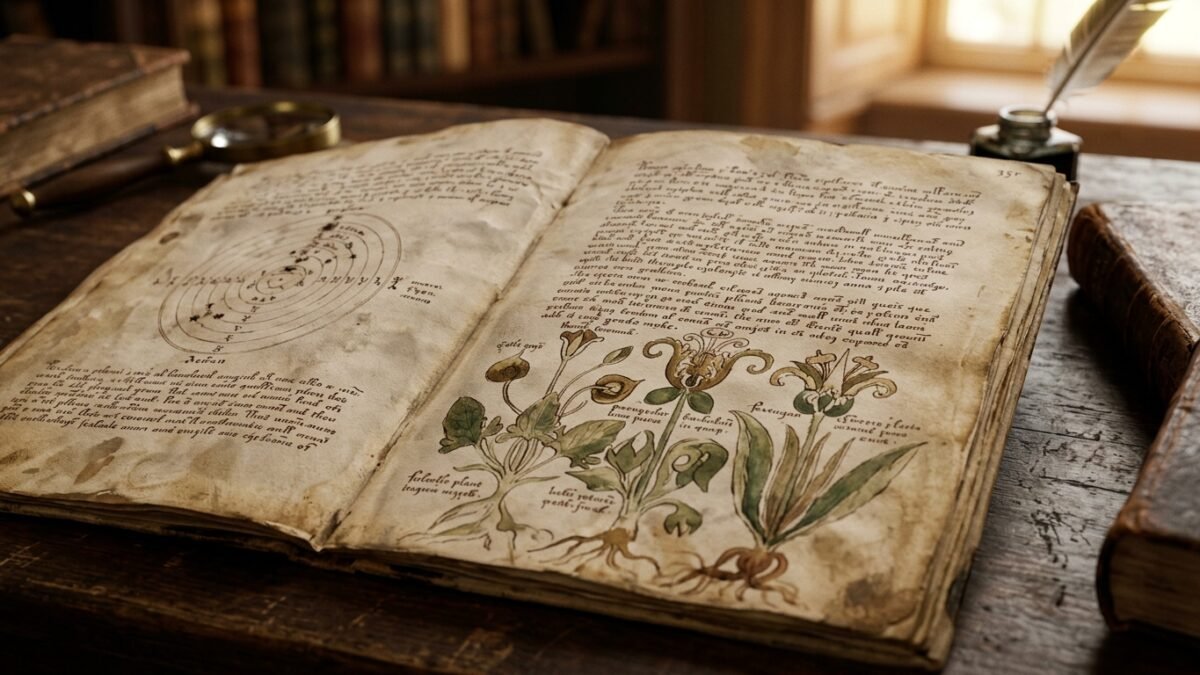
In the climate-controlled vaults of Yale University’s Beinecke Rare Book and Manuscript Library lies an unassuming medieval codex labeled Beinecke MS 408. Spanning 240 calfskin vellum pages, it is arguably the most enigmatic physical book in human history: the Voynich Manuscript.
Written in an elegant, flowing script that appears in no other known historical document, and embellished with hundreds of hand-painted illustrations of alien-looking flora, naked nymphs bathing in interconnected tubes, and astrological star charts, it has resisted decipherment by the world’s sharpest minds for over a century.
Scientific Confirmation: Real Medieval Origins
For decades, skeptics speculated that the book was a modern forgery created by antiquarian dealers seeking a fortune. However, in 2009, a team of scientists at the University of Arizona conducted extensive Accelerator Mass Spectrometry (AMS) radiocarbon dating on multiple pages.
The results were definitive: the calfskin vellum was prepared between 1404 and 1438 AD during the early Italian Renaissance. Chemical analysis of the tempera paints and ink verified that the materials, binders, and pigments are completely consistent with 15th-century European manuscript fabrication.
The Mystery of “Voynichese”: Hoax or Language?
The text—dubbed “Voynichese” by linguists—is composed of an alphabet of roughly 25 to 30 glyphs. What makes the manuscript so tantalizing is that it behaves like a genuine, functioning human language:
- Zipf’s Law Compliance: In every natural human language, the frequency of any word is inversely proportional to its rank in the frequency table (the most common word occurs roughly twice as often as the second most common). Voynichese adheres to Zipf’s law with mathematical perfection.
- Information Entropy: Statistical word-order entropy tests demonstrate predictable syllabic prefixes and suffixes, closely mirroring the semantic density of Semitic or Indo-European tongues.
- Absence of Strikethroughs: Medieval scribes routinely made errors, crossing out words or correcting lines in the margin. The Voynich script contains virtually zero corrections, flowing across the vellum with astonishing, uninterrupted fluidity.
The Four Fascinating Sections of the Codex
1. The Herbal Section
Contains 113 drawings of unidentified plants. While individual parts look familiar (a dandelion petal, a fern leaf, an iris root), the parts are bizarrely grafted together into composite botanical chimeras that do not correspond to any known species on Earth.
2. The Astrological and Cosmological Section
Features folding circular diagrams containing medieval zodiac symbols (Taurus, Pisces, Aries) surrounded by tiny female figures emerging from stars, accompanied by concentric planetary orbits.
3. The Balneological Section
Perhaps the strangest chapter in the book: intricate mechanical networks of green water pools, miniature plumbing pipes, and translucent fluids carrying cheerful nude women bathing in complex thermodynamic systems.
4. The Pharmaceutical and Recipe Section
Small labeled pots and apothecary jars alongside roots, leaves, and short paragraph entries marked by miniature flower asterisks, resembling a medieval medical pharmacopeia.
Despite modern attempts using supercomputers, military cryptanalysts, and neural machine translation models, the Voynich Manuscript keeps its counsel—a tangible testament that human history still holds mysteries that refuse to be decoded.