Just reading the headline of this article might have made you want to yawn. In fact, if you just inhaled deeply and stretched your jaw, you are not alone. Contagious yawning is one of the most widespread yet misunderstood neurological phenomena in the animal kingdom.
For hundreds of years, teachers and doctors repeated the myth that yawning serves to flood the bloodstream with oxygen when we are tired. But when physiologists tested this hypothesis by placing participants in oxygen-controlled chambers, yawning rates remained completely unchanged.
The Thermoregulatory Hypothesis: A Biological Radiator
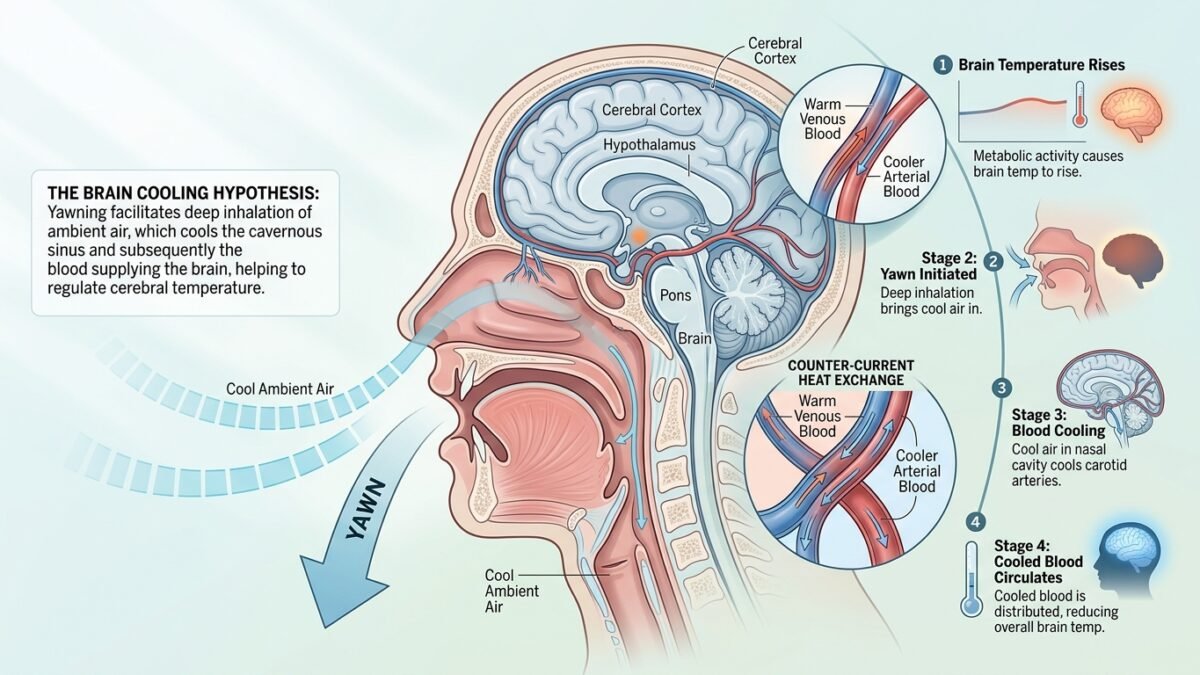
In the mid-2000s, evolutionary psychologist Dr. Andrew Gallup proposed an elegant explanation supported by extensive experimental data: yawning functions as a brain-cooling mechanism.
The human brain consumes approximately 20% of the body’s total metabolic energy while occupying just 2% of body mass. This intense metabolic activity generates substantial localized heat. Just like a high-performance computer CPU, your brain operates optimally within a narrow temperature range.
When you yawn, several physiological processes take place simultaneously:
- Cranial Blood Displacement: The powerful stretching of the jaw increases blood flow to the neck, face, and head.
- Convective Cooling: The deep inhalation of ambient air cools the blood vessels lining the nasal and oral cavities.
- Counter-Current Heat Exchange: This cooler venous blood circulates back into the brain, dissipating localized heat and maintaining cognitive alertness.
Why Is It Contagious?
If yawning is a physiological cooling mechanism, why does watching someone else yawn cause us to mirror the behavior? The answer lies in social neuroscience and evolutionary survival.
Humans are deeply social primates. In ancestral hunter-gatherer bands, group vigilance was essential for survival against predators. When one member of a group experienced a shift in mental state or alertness, synchronizing vigilance across the entire group offered an evolutionary advantage.
Neurological imaging shows that witnessing a yawn activates the mirror neuron system and areas associated with social empathy—including the medial prefrontal cortex. Intriguingly, individuals who score higher on empathy scales exhibit stronger susceptibility to contagious yawning.