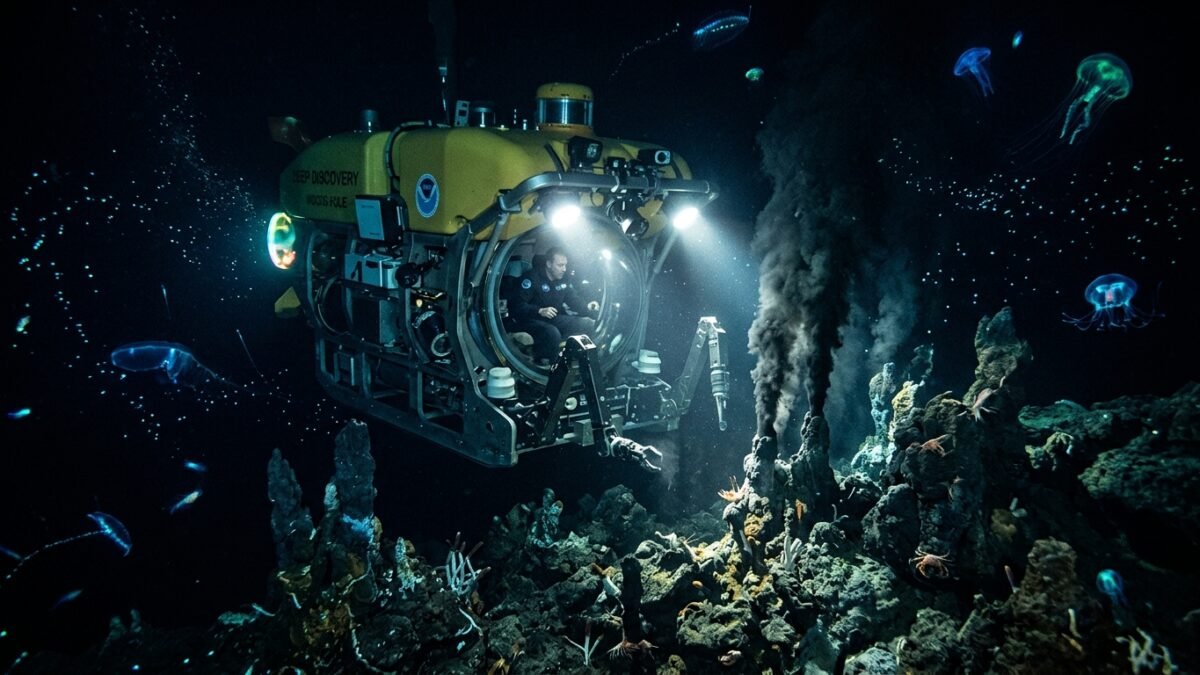
If you inverted Mount Everest into the deepest part of the Mariana Trench, its snow-capped peak would still sit more than two kilometers beneath the ocean waves. Located in the western Pacific near Guam, the Challenger Deep descends roughly 10,935 meters (35,876 feet) into the abyss.
For decades, oceanographers assumed that this “hadal zone”—named after Hades, the Greek god of the underworld—was a biological wasteland: perpetual darkness, near-freezing temperatures (1°C to 4°C), and crushing hydrostatic pressure. Yet robotic probes and crewed submersibles have revealed a flourishing, alien ecosystem.
The Physics of Extreme Pressure
At the bottom of the trench, water pressure exceeds 1,000 atmospheres. At this depth, normal biological enzymes and cellular proteins undergo structural collapse. The cell membranes that hold life together would solidify into rigid wax under such forces.
To survive, hadal creatures rely on specialized organic molecules called piezolytes (from the Greek piezin, to squeeze). The most prominent piezolyte is trimethylamine N-oxide (TMAO), a compound that binds tightly with water molecules to form a protective water scaffold around cellular proteins, preventing pressure from warping their functional shapes.
Meet the Hadal Inhabitants
1. The Mariana Snailfish (Pseudoliparis swirei)
Holding the record as the deepest-living fish ever documented (discovered at depths exceeding 8,000 meters), the Mariana snailfish looks less like a ferocious predator and more like a translucent, scaleless tadpole. It has no swim bladder, cartilage-like flexible bones, and high concentrations of TMAO, making it the apex predator of the trench slope.
2. Giant Xenophyophores
Xenophyophores are gigantic single-celled protozoans that can grow up to 10 centimeters (4 inches) across—thousands of times larger than ordinary single cells. They construct delicate shell structures out of sediment and sediment sponge spicules, serving as foundational micro-habitats for small amphipods on the trench floor.
3. Supergiant Amphipods (Alicella gigantea)
While shallow-water beach fleas and amphipods are typically a few millimeters long, hadal trench amphipods exhibit deep-sea gigantism, growing up to 34 centimeters (over a foot long). They scavenge organic detritus (known as “marine snow”) that slowly drifts down from the sunlit surface waters miles above.
The Chemosynthetic Food Web
While some nutrients drift down from above, deep ocean trenches also host vibrant chemoautotrophic microbial mats. In hydrothermal seeps and serpentinization vents along the trench walls, sulfur- and methane-oxidizing bacteria generate organic carbon entirely without sunlight, proving that life on Earth can thrive in conditions as extreme as the moons of Jupiter and Saturn.