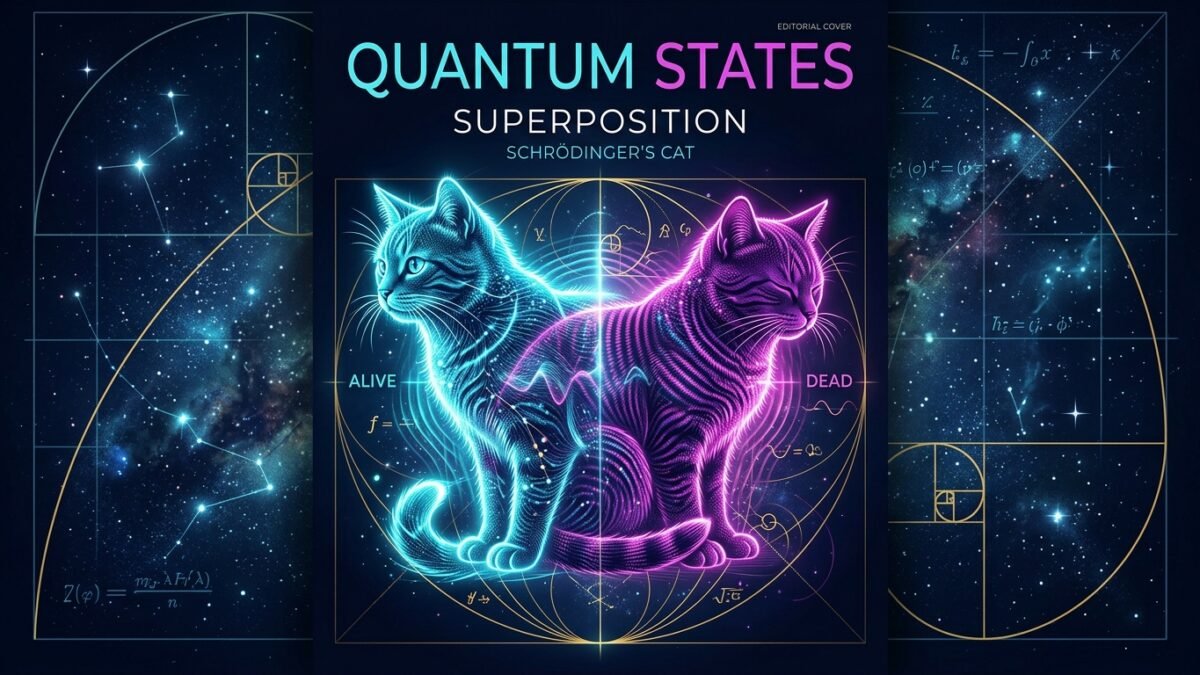
Almost everyone has encountered the famous thought experiment: a cat is placed inside a sealed steel chamber with a radioactive atom, a Geiger counter, a vial of poison, and a small hammer. If the atom decays, the hammer shatters the vial and the cat dies; if it does not decay, the cat lives. According to quantum mechanics, until an observer opens the box, the cat is both alive and dead at the same time.
It is one of popular science’s most enduring metaphors. But what few people realize is that Austrian physicist Erwin Schrödinger did not invent this thought experiment to explain how quantum mechanics worked—he invented it to demonstrate how utterly ridiculous he thought it sounded.
The Copenhagen Interpretation and the Crisis of Reality
In the 1920s, luminaries like Niels Bohr and Werner Heisenberg established the Copenhagen interpretation of quantum mechanics. At subatomic scales, particles like electrons and photons do not behave like tiny billiard balls occupying definite points in space. Instead, they exist as waves of probability described by the Schrödinger wave equation.
Until a measurement or observation takes place, a particle exists in a state of superposition: a linear combination of all its possible physical states at once. It is not secretly in State A or State B; it mathematically exists across all available possibilities simultaneously.
Why Don’t We See Superposition in Daily Life?
If subatomic particles can exist in multiple states at once, and everyday objects (like coffee mugs, trees, and humans) are made of subatomic particles, why doesn’t your laptop exist in a superposition of being in your bag and on your desk simultaneously?
The answer is a phenomenon known as quantum decoherence.
- An isolated subatomic particle inside a cryogenically cooled vacuum chamber can maintain its delicate wave superposition because nothing is disturbing it.
- A macroscopic object like a cat contains roughly $10^{26}$ atoms constantly colliding with air molecules, photons of light, and thermal radiation.
- Each micro-collision carries away phase information, causing the wave state to “decohere” into a single, predictable classical state in less than a sextillionth of a second ($10^{-23}$ seconds).
From Thought Experiment to Quantum Computers
Far from being an academic parlor trick, quantum superposition is now the foundation of the 21st century’s most profound technological revolution: quantum computing.
Classical computers process information in binary bits: switches that must be either $0$ (off) or $1$ (on). Quantum computers operate on qubits. Because qubits leverage superposition, a single qubit can be $0$, $1$, or any quantum blend of both at the same time.
When qubits are linked together through quantum entanglement, their computational capacity grows exponentially. While a classical supercomputer might take 10,000 years to simulate complex molecular drug interactions or optimize global logistics grids, a quantum processor harnesses superposition to evaluate all permutations simultaneously in minutes.
Schrödinger’s cat started as a whimsical protest against the unintuitive nature of our universe. Today, it stands as proof that the deeper we peer into reality, the more wondrous and boundless nature turns out to be.