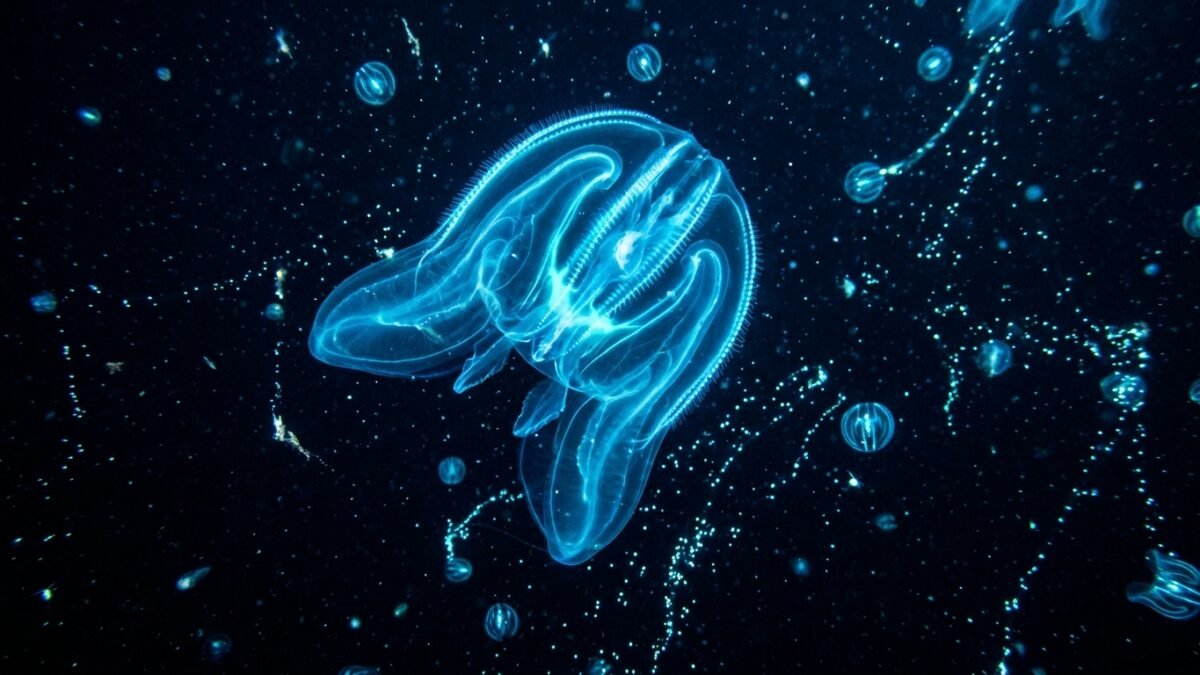
Descend just 200 meters beneath the surface of the world’s oceans, and the golden warmth of the sun fades into an eerie, perpetual twilight. Descend past 1,000 meters into the bathypelagic midnight zone, and sunlight vanishes completely. Yet this immense watery expanse—encompassing over 90% of Earth’s habitable living space—is far from dark.
According to surveys conducted by the Monterey Bay Aquarium Research Institute (MBARI), more than 76% of all deep-sea animals are biological lanterns, generating their own cold, ethereal light.
The Physics of “Cold Light”: The Luciferin Engine
Human incandescent lightbulbs are shockingly inefficient: 90% of the electrical energy is wasted as heat, producing only 10% visible light. Bioluminescence, by contrast, is nearly 100% energy efficient. It generates virtually zero waste thermal energy, earning it the scientific classification of “cold light.”
This miraculous reaction relies on two core chemical components:
- Luciferin: A generic term for a family of heterocyclic light-emitting substrate molecules.
- Luciferase: A specialized catalyst enzyme that accelerates oxidation.
When luciferin bonds with molecular oxygen in the presence of luciferase, adenosine triphosphate (ATP), and trace ions like magnesium, it enters an unstable electronically excited state. As the compound relaxes back into its ground state, it sheds excess energy in the form of photons—producing a dazzling flash of blue-green light.
Evolutionary Masterpieces of Living Light
1. Counter-Illumination: The Cloak of Invisibility
In the ocean twilight zone, dangerous predators swim looking upward to spot the silhouettes of prey outlined against the faint surface sunlight. Animals like the hatchetfish and firefly squid have rows of light-emitting organs called photophores lining their bellies.
Using sensitive dorsal eyes to meter ambient downwelling light, they calibrate their ventral photophores to match the exact intensity and wavelength of sunlight filtered from above. To an apex predator swimming below, the prey’s silhouette disappears entirely—a living optical cloaking device.
2. The “Burglar Alarm” Display
Certain species of translucent jellyfish and dinoflagellates cannot swim fast enough to flee predators. Instead, when attacked, they unleash an explosive, high-intensity bioluminescent strobe display. This display is not meant to scare the predator directly; it is designed to illuminate the attacker for much larger tertiary predators, essentially calling the “police of the deep.”
3. Symbiotic Bacterial Alliances
Not every luminous animal produces their own luciferin. Creatures like the deep-sea anglerfish and the Hawaiian bobtail squid host billions of glowing bioluminescent bacteria (such as Aliivibrio fischeri) inside specialized organ chambers. The animal feeds the bacteria essential sugars and amino acids, and in return, the bacteria provide a glowing lure or navigational beacon.
From medical diagnostics tracking viral infections to future eco-friendly genetic plant lighting, ocean bioluminescence reminds us that the darkest depths of our planet hold its most illuminating secrets.