For over a century, classical forestry viewed a woodland through the lens of strict Darwinian competition: every tree fighting its neighbor for sunlight, soil water, and nitrogen. But when ecologists peered beneath the forest soil with isotopic tracers, they discovered something extraordinary.
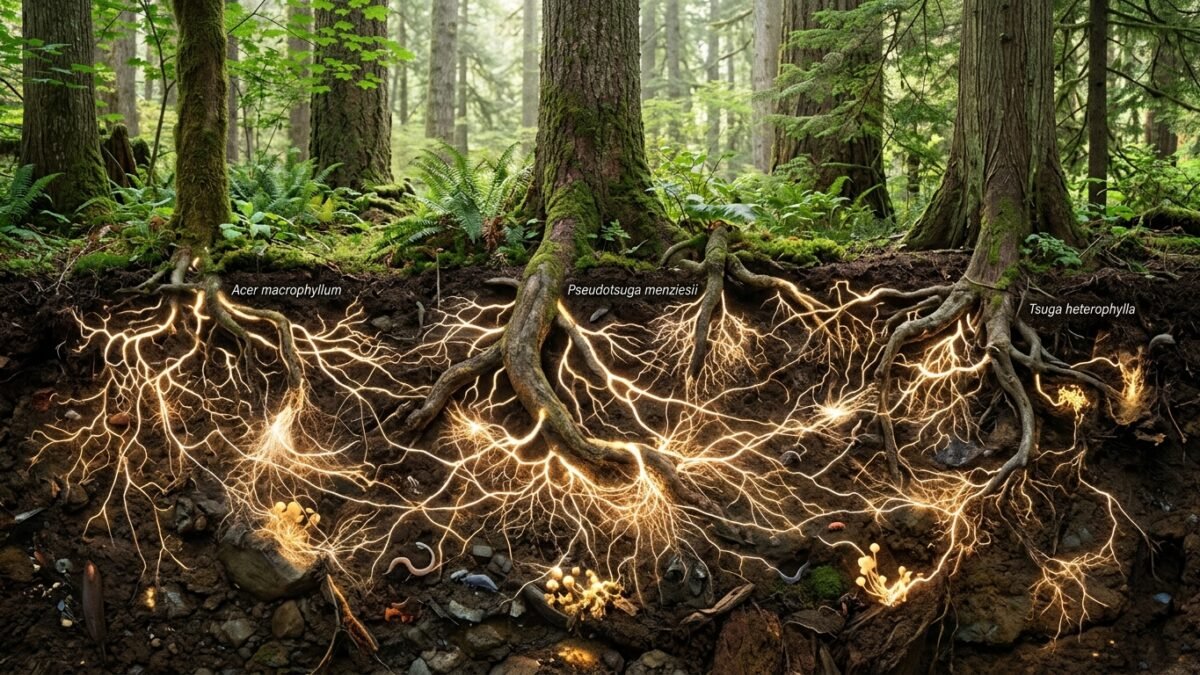
Trees are not isolated individuals. They are interconnected nodes in a vast, subterranean social network mediated by microscopic fungal filaments—a biological internet colloquially known as the Wood-Wide Web.
The Symbiotic Bargain: Fungi and Roots
At the heart of this network is the mycorrhizal symbiosis (from the Greek mykes meaning fungus and rhiza meaning root). Trees are photosynthetic powerhouses capable of turning sunlight and carbon dioxide into rich sugars, but their woody root systems are relatively coarse and inefficient at extracting scarce soil minerals like phosphorus and nitrogen.
Mycorrhizal fungi, on the other hand, produce microscopic thread-like structures called hyphae that are hundreds of times finer than root hairs. These threads penetrate tiny rock fissures and absorb water and dissolved minerals with remarkable efficiency.
The two organisms strike a biological trade agreement: the tree provides up to 30% of its photosynthetic carbon sugars to the fungus, and the fungus provides essential minerals and moisture to the tree.
Mother Trees and Resource Redistribution
Because fungal mycelium connects not just one tree, but hundreds of trees across multiple species, it creates an underground distribution grid. In a mature forest, the largest, oldest trees—dubbed “Mother Trees”—occupy the canopy and receive abundant sunlight.
Understory saplings growing in deep shade cannot photosynthesize enough to survive on their own. Studies using carbon isotope tracking revealed that Mother Trees pump carbon through the fungal network directly into shaded young seedlings, effectively nursing them until a gap in the canopy opens.
Early Warning Defense Systems
Perhaps most startling is the communication function of mycorrhizal networks. When an aphid or caterpillar infestation attacks a tree, that tree synthesizes chemical defense compounds (such as bitter tannins) while simultaneously releasing biochemical distress signals into the fungal grid.
Neighboring trees that have not yet been touched by pests detect these subterranean signals and begin producing defensive enzymes preemptively, rendering their leaves unpalatable before the insects even arrive.