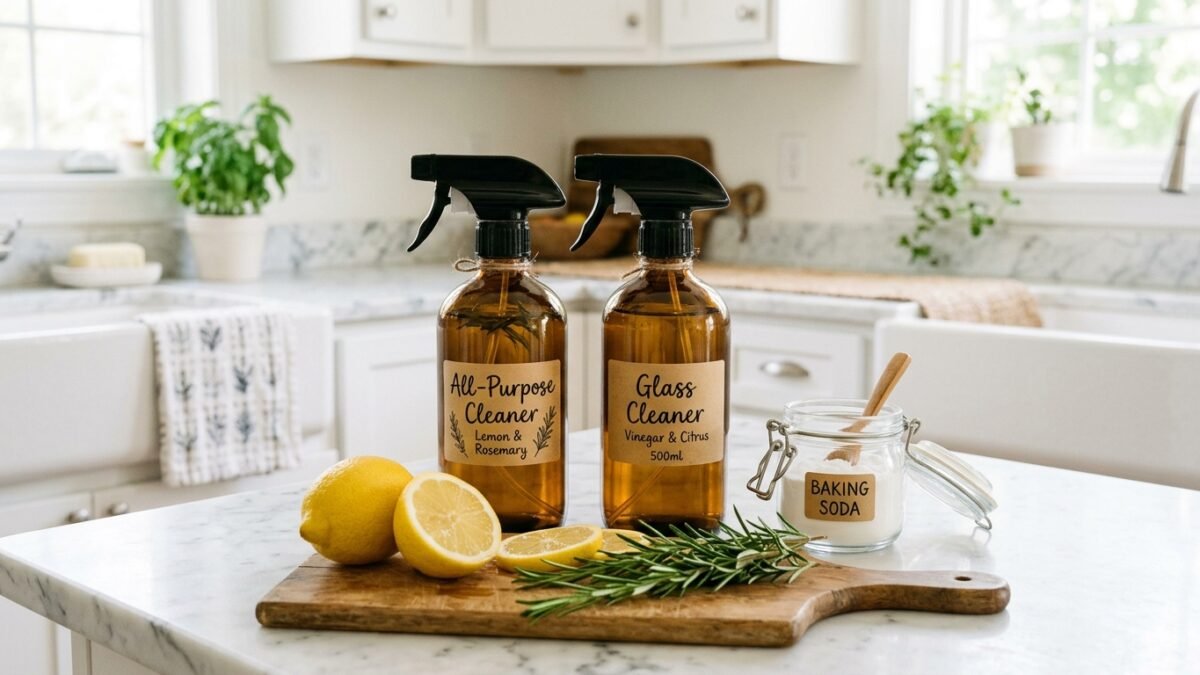
Walking into the cleaning aisle of a modern supermarket can be overwhelming: shelves filled with artificial dyes, synthetic fragrances, and aggressive chlorine compounds that irritate respiratory passages and indoor air quality.
Yet many well-intentioned DIY “green cleaning” hacks popular on social media violate basic high school chemistry. By understanding how pH scales and surfactant molecules work, you can concoct low-tox formulas at home that outperform commercial cleaners at a fraction of the financial and ecological cost.
The Golden Rule of Cleaning Chemistry: pH Matching
In cleaning science, opposites dissolve opposites. Dirt, grease, and mineral deposits fall along different points on the pH scale:
- Acidic soils (grease, body oils, food fats): Dissolved best by alkaline / basic cleaners (pH 8 to 11) such as Castile soap, washing soda, or baking soda paste.
- Alkaline soils (hard water limescale, soap scum, mineral deposits): Dissolved best by acidic cleaners (pH 2 to 4) such as distilled white vinegar or citric acid solutions.
5 Tested Science-Backed Formulas
1. The Heavy Mineral Descaler (Citric Acid Solution)
Vinegar smells pungent and takes hours to soften heavy calcium carbonate. Citric acid is odorless, food-safe, and significantly more potent. Dissolve 2 tablespoons of food-grade citric acid powder in 2 cups of hot distilled water. Spray onto glass shower doors, faucet aerators, or kettle interiors; allow to sit for 15 minutes, then wipe clean. The limescale dissolves effortlessly.
2. The Kitchen Counter Degreaser (Castile Surfactant)
Surfactant molecules possess a hydrophilic (water-loving) head and a lipophilic (oil-loving) tail. The tail binds to greasy splatters, while the head pulls the fat into water suspension. Mix 2 tablespoons of liquid Castile soap with 2 cups of distilled water and 10 drops of tea tree or orange peel essential oil. Shake gently and spray on stovetops and countertops.
3. The Hospital-Grade Sanitizer (Hydrogen Peroxide 3%)
Hydrogen peroxide ($H_2O_2$) works through oxidation, generating hydroxyl free radicals that rip apart bacterial cell membranes and viral lipid envelopes, breaking down cleanly into water and oxygen. Keep a spray nozzle screwed directly onto a standard brown pharmacy bottle (light degrades peroxide). Spray onto cutting boards or bathroom fixtures, let remain wet for 10 minutes, and air dry.
4. The Heavy-Duty Grout Scrub (Baking Soda & Surfactant Paste)
Instead of mixing baking soda with vinegar, mix 1 cup of sodium bicarbonate with 2 tablespoons of liquid Castile soap and 1 tablespoon of hydrogen peroxide into a thick frosting paste. Apply with a stiff brush to tiled grout or stained stainless steel sinks. The mild alkaline abrasive scrubs without scratching enamel.
5. The Crystal Glass & Mirror Polish
For streak-free mirrors, mix 1 cup of distilled water, 1 cup of 70% isopropyl alcohol, and 1 tablespoon of white vinegar. The alcohol evaporates in seconds, while the vinegar cuts through hairspray residue, leaving mirrors impeccably clear.